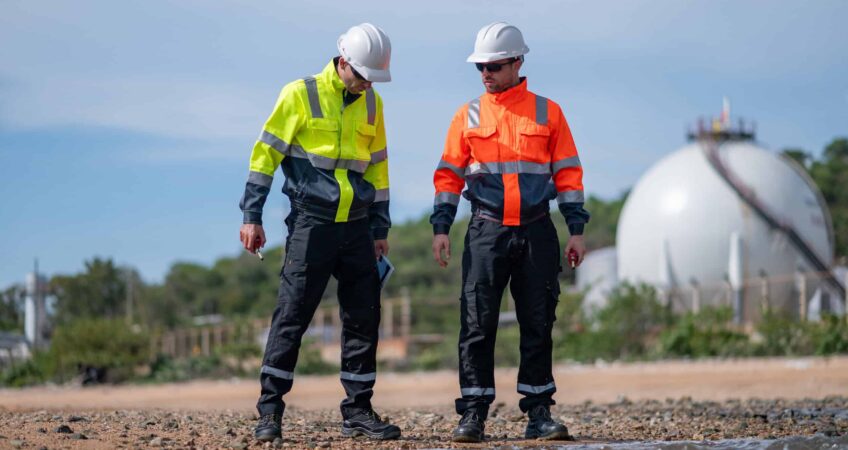
When you’re working in oilfields or production facilities, uniforms aren’t just about looking professional. They’re a critical piece of your safety equipment. Getting your oil uniforms safety program right can mean the difference between preventing serious injuries and facing regulatory fines or worse.
The thing is, OSHA has specific requirements for a reason. Flash fires and burn injuries are real risks in this industry, and the right uniforms can protect your crew.
Below, we’ll walk you through what you need to know to set up a uniform program that keeps your team safe and your operation compliant.
The Regulatory Foundation for Oil Uniforms Safety
Before choosing uniforms, you must understand what drives the requirement. For example, OSHA’s 29 CFR 1910.132 sets the general duty for personal protective equipment (PPE). It states that “protective equipment … shall be provided, used, and maintained in a sanitary and reliable condition” when hazards exist.
Additionally, OSHA’s enforcement policy for flame‐resistant clothing (FRC) in oil and gas drilling, servicing and production operations clarifies that employers must provide FRC where flash fire risks are present.
These regulatory fundamentals form the basis for oil uniforms safety programs: hazard assessment, selection of appropriate garments, maintenance, training, and documentation.
Step 1: Conduct a Hazard Assessment
You can’t pick the right uniforms until you know what dangers your workers deal with every day.
Identify Flash Fire and Thermal Risks
Flash fires are a real problem in oil and gas work. One second everything’s fine, the next you’ve got flames racing through vapor, gas, or dust because something sparked. If your assessment shows this could happen at your site, flame-resistant uniforms aren’t just a good idea. They’re necessary.
Follow OSHA Standard 1910.132(d)
OSHA expects you to assess the hazards in your workplace, choose appropriate PPE, and document the whole process. When it comes to uniforms, you need to look at the specific tasks your employees handle, figure out where ignition sources are present, consider the possibility of flames or arc flashes, and make sure the clothing fits properly and functions in real-world situations.
Step 2: Choose the Right Uniforms
Now that you know what you’re dealing with, you can pick uniform rental options that’ll keep your people safe.
Pick Flame-Resistant Garments
Flash fire risk showed up in your assessment? Then you need clothing that meets NFPA 2112 and NFPA 2113. Those standards cover the garments and how to pick them, clean them, and use them right. OSHA points to these standards too, so you’re covering compliance and safety at the same time.
Make Sure Uniforms Fit the Work
Being flame-resistant is just the starting point. Your uniforms have to work for the actual jobs people do:
- Let workers move around without fighting their clothes
- Keep air flowing so people don’t overheat
- Cover skin that could get exposed
- Hold up in whatever conditions you’ve got (brutal heat, weather, tight spaces)
Step 3: Set Up Maintenance and Cleaning Protocols
Great uniforms won’t help much if nobody’s taking care of them.
Inspect and Repair Regularly
Look for ripped seams, labels that fell off, stuff that got contaminated, or damage from washing. Set up a schedule for checking and yank damaged items out of rotation right away. OSHA says this is on you, so it’s not something you can skip.
Clean Uniforms Correctly
Doesn’t matter if you’re doing laundry yourself or paying someone else. The wash has to keep the flame resistance working. Sometimes washing at home is fine if you follow what the manufacturer says, but you’re responsible either way.
Keep Records
Write down your inspections, what you fixed, what you replaced, how you’re cleaning things, and what your hazard assessments found. This paperwork shows your program’s actually running and keeps audits from turning into nightmares.
Step 4: Train Your Team
None of this matters if your crew doesn’t get it or won’t stick to it.
Educate Employees
People need to understand why they’re wearing these uniforms, how to put them on right, what won’t protect them, how to keep the clothes working, and when something’s wrong enough to speak up. OSHA standard 1910.132(f) says you have to train on this stuff, and really, it just makes sense.
Enforce Compliance
Your managers and supervisors have to watch that people are wearing uniforms the way they’re supposed to, swap out damaged ones fast, and hold everyone to the same rules. The best safety equipment in the world doesn’t help if nobody’s using it.
Step 5: Monitor and Improve Your Program
Setting up a uniform program isn’t a one-and-done thing. You’ve got to keep checking on it.
Run Regular Audits
Go through your hazard assessments, look at uniform condition, check cleaning records, see if people are complying, and review your paperwork. Doing this regularly helps you spot trouble before it gets bad and keeps everything lined up with how work actually happens.
Update When Things Change
New equipment? Different drilling approach? Moving to another production area? Time to look at your hazard assessment again and adjust what uniforms you need. Your operation moves forward, and your safety setup needs to move with it.
Track the Numbers
Pay attention to things like:
- How uniforms hold up over time
- How often you’re replacing them
- Problems with how they’re getting cleaned
- What employees are telling you
- Any incidents that involve the uniforms
These numbers show if your program’s doing its job or if you need to fix something.
Strengthen Your Oil Uniforms Safety Program Today With SPARKLE!
Safety starts with the right uniforms. SPARKLE Uniform & Linen Service provides OSHA-compliant flame-resistant garments with commercial-grade cleaning and on-time delivery. We handle the uniforms so you can focus on keeping your operation safe.
Contact SPARKLE today at 661-634-1130 or visit sparklerental.com. Serving Bakersfield, Tulare, Porterville, Lake Isabella, and Taft since 1949.